


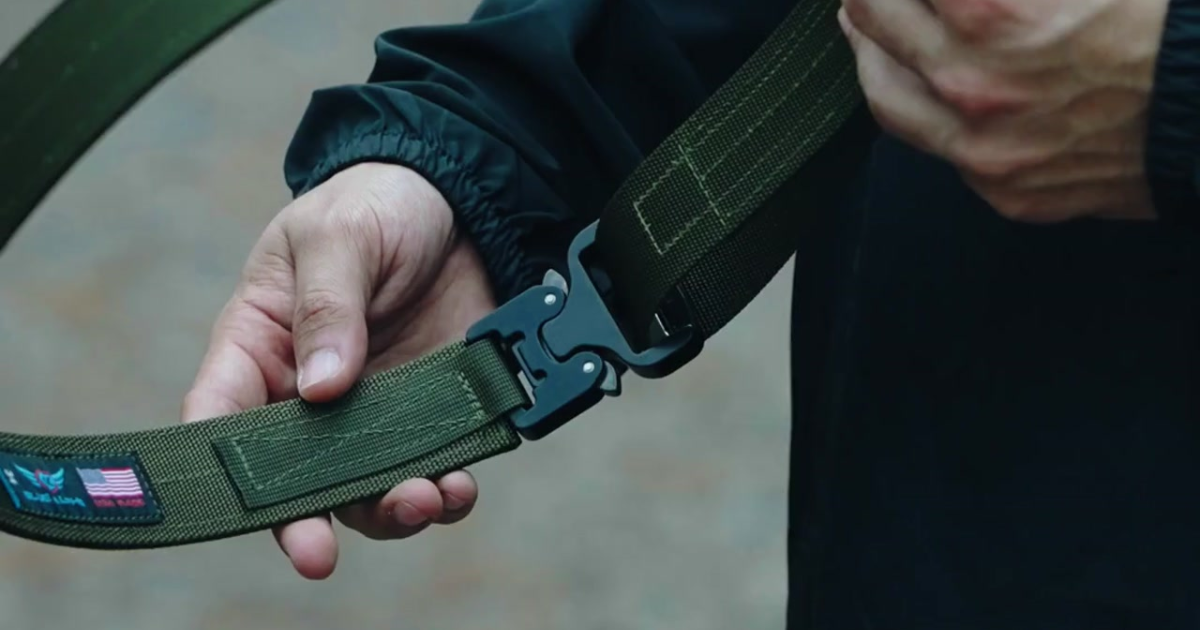
EDC Belt Features That Matter (and What to Avoid)
An EDC-ready belt isn’t just about holding your pants up. It’s a piece of gear that has to work hard every single day. Whether you carry a concealed firearm, tools, or other everyday carry gear, your belt must do four key things and do them well.
- Support the weight of your EDC load. That means supporting the full weight of your firearm, holster, spare mags, multitool, flashlight – whatever your setup includes.
- Stay rigid without giving up comfort. You need a belt that’s rigid enough to keep your holster upright and in place, but flexible enough to move with you throughout the day.
- Enable a smooth, consistent draw. When you practice your draw, you’re training for consistency. Your belt should help with that. If your holster shifts or sags, your draw angle changes, and that messes with your muscle memory.
- Integrate with holsters and EDC accessories. Your belt is the base layer for your whole carry system. It needs to work well with others, whether that’s a paddle holster, an OWB rig, magazine pouches, or a dedicated gear belt setup.
Stiffness and Structure
Without the right stiffness and structure, even the most expensive belt will sag, twist, or shift once you load it up with your everyday carry gear. That’s not just annoying. It will throw off your draw, mess with concealment, and wear out your gear faster.
The strength of your EDC belt starts at the core.
A properly structured EDC belt resists sagging at the hips, holds your firearm in the same position all day, and gives you the same draw angle whether you’re sitting, standing, or moving.
Single-Layer vs. Reinforced EDC Belts
Not all belts are built the same. Single-layer belts (even ones made from decent nylon) tend to fold or flex when loaded with gear. They’re fine for light use, but don’t cut it for concealed carry or tactical setups.
Reinforced belts are a different story. These belts are built with added materials (like rigid inserts or multiple layers of webbing) that help them maintain shape and strength under pressure.
Here’s the difference in real terms:
- Single-layer belts: More flexible, but prone to sagging. Good for casual wear or minimal setups.
- Reinforced belts: Maintain shape and resist deformation. Ideal for daily concealed carry or full-duty use.
For instance, Blue Alpha’s EDC belts are purpose-built with structure in mind. We use dual-layer nylon webbing that adds rigidity without turning the belt into a stiff board. This design gives you the support you need without sacrificing comfort or flexibility.
Design and Adjustability
The buckle on your EDC belt isn’t just a closure system. It affects how your gear rides, how easy it is to get the belt on and off, and how well your setup stays consistent.
Quick-Release vs. Traditional Buckles
There are two main types of buckles you’ll see on EDC belts: quick-release and traditional styles.
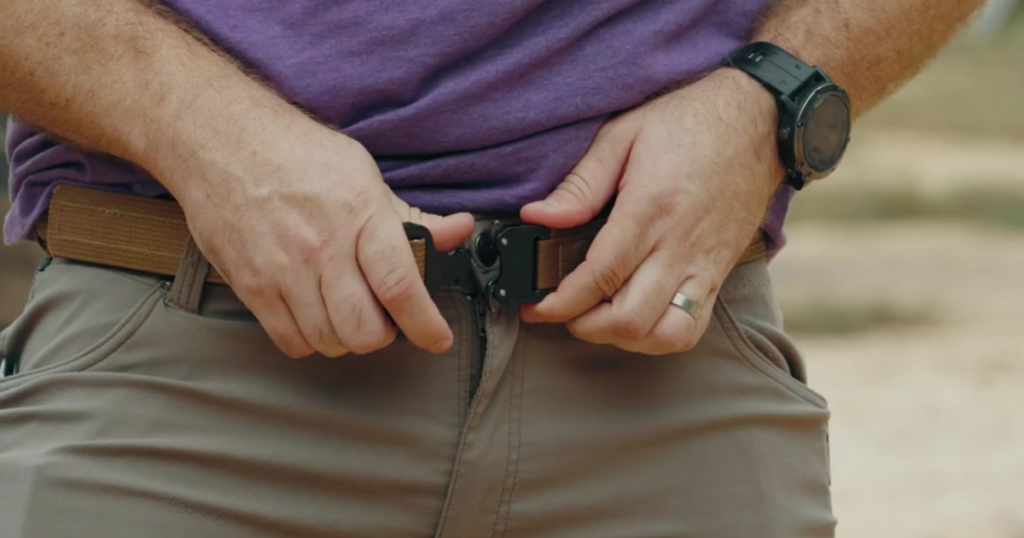
- Hybrid or heavy-duty buckles are known for strength and speed. They’re tough enough for duty use and can be unbuckled quickly with one hand. The downside? They can be bulkier, which may create a bump under your shirt.
- Low-profile buckles are easier to conceal and more comfortable when sitting or bending. They may take a second longer to remove, but they’re lighter and more streamlined for daily wear.
There’s no one right answer here. It depends on how and where you carry. For more about buckles, read Gun Belt Buckles Explained.
The Power of Micro-Adjustments
Here’s where adjustability matters. A belt that only adjusts in inch-wide increments can leave you between sizes, either too loose to support your gear or too tight to stay comfortable.
Belts with hook-and-loop closure or fine-tuned hardware let you dial in the fit. That’s better for:
- Comfort throughout the day as your body moves or changes (like after lunch).
- Consistent draw because your holster position stays locked in at the same angle.
- Concealment, especially when trying to reduce printing under a t-shirt or fitted jacket.
This mix of features helps you set your belt exactly where it needs to be with no sag, no slip, and no unnecessary bulk.
Durability and Hardware
An EDC belt should last, not just hold up for a few months. It must withstand daily wear, sweat, movement, and weight for years.
That kind of durability doesn’t come from style-first fashion belts. It comes from smart design, rugged materials, and build quality that holds up under real-world pressure.
That’s why durability starts with the basics:
- Heavy-duty stitching that doesn’t fray or come loose under stress.
- Tough materials (like reinforced nylon webbing) that resist wear and keep their shape.
- Corrosion-resistant buckles that won’t rust or seize, even if they get wet.
Regular Belt vs. EDC Belt
At first glance, a belt is a belt – right? Not quite.
One of the most common misconceptions is that a thick leather belt equals a strong belt. But thickness alone doesn’t guarantee support. Many thick belts still fold or twist under load because they lack internal structure.
A well-made EDC belt might look simple, but what matters is inside: reinforced layers, durable stitching, and materials that stay stiff under pressure. It’s not about bulk. It’s about design.
Let’s break down the difference between an everyday fashion belt and a purpose-built EDC belt like the ones from Blue Alpha.
| Feature | Regular Belt (Department Store) | EDC-Ready Belt |
| Core Material | Thin leather or single-ply fabric | Reinforced dual-layer nylon webbing |
| Stiffness | Soft and flexible | Rigid enough to support full EDC load |
| Buckle Hardware | Decorative or lightweight metal | Heavy-duty metal or polymer options |
| Adjustability | Fixed holes or minimal adjustment | Micro-adjustable with hook-and-loop |
| Load Support | Sags under weight | Holds holsters, pouches, and more |
| Durability | Cracks, stretches, or warps easily | Built for years of daily use |
The takeaway? A fashion belt may look sharp, but it’s not designed to handle the demands of concealed carry or everyday gear. A good EDC belt is built from the ground up to do that job, and do it well.
Blue Alpha: EDC Belts Built for Real Life
For EDC belts, Blue Alpha doesn’t believe in one-size-fits-all. We offer several EDC-ready options, each designed to meet different needs without compromising strength or comfort.
Low Profile EDC Belt: This belt is minimalist, flexible, and designed to disappear under your clothes. It is perfect for concealed carry and everyday use. The hook-and-loop closure keeps the bulk down and makes the belt fit tight.
EDC Hybrid Belt: Combines a sleek design with the strength of a Cobra buckle. Gives you the durability of a tactical belt with a more streamlined, casual look.
Low Profile Inner/EDC Belt: Designed to double as an everyday EDC belt and an inner belt for range or duty use. The loop exterior allows it to attach securely to a duty or battle belt, while still functioning as a standalone belt for concealed carry.
Each belt is stiff where it needs to be and comfortable where it counts. It holds your holster steady, allows consistent draw angles, and adjusts for a perfect fit even when your gear changes.
What Makes a Belt Truly EDC-Ready
A great EDC belt does more than just complete your outfit. It supports your carry system from the ground up. If your current belt can’t do all that, it’s time to upgrade.